

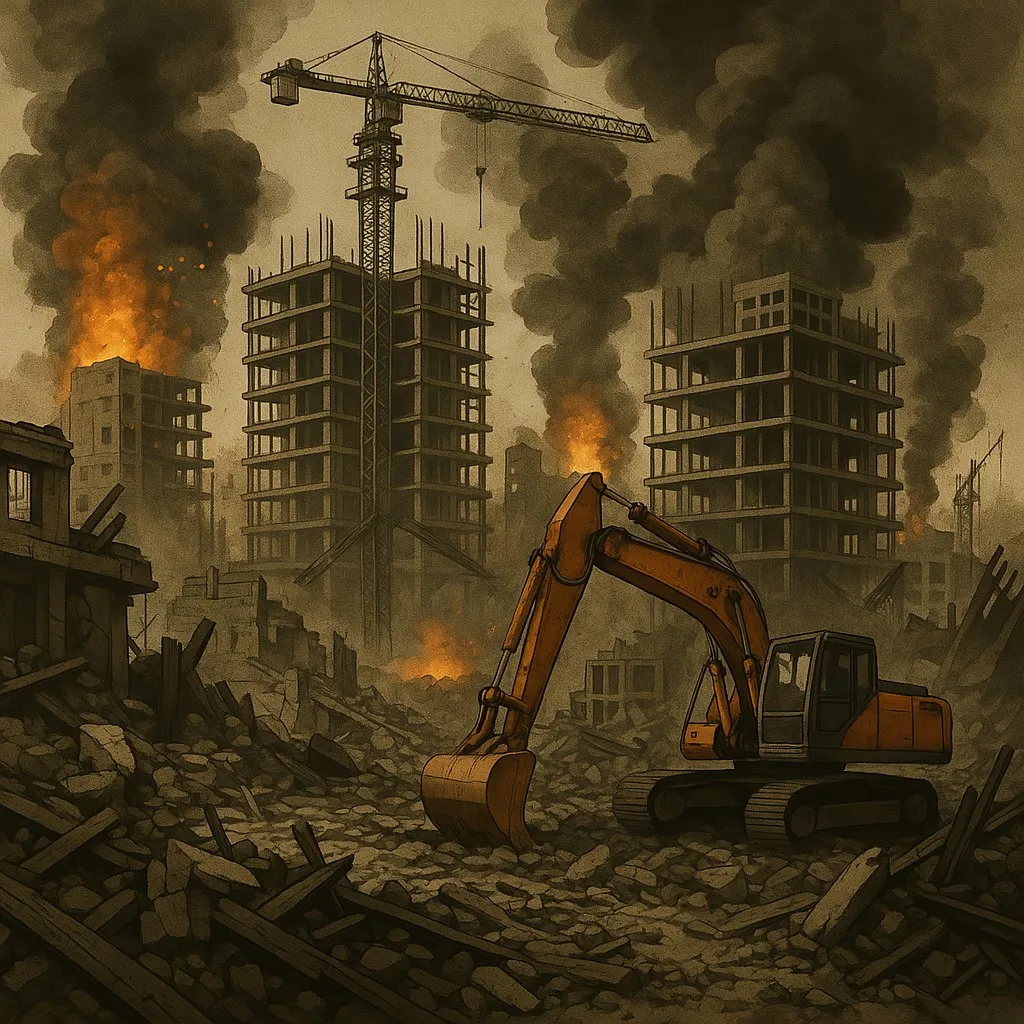
Examining the Impact of War on the Construction Industry Market and Its Solutions
Introduction
This report examines the impact of war on construction activity, sales of construction products, and the strategies required for the construction industry during wartime. The data has been extracted from reliable sources, including academic articles and industry reports, and is presented based on available analyses, particularly those concerning recent wars such as the Russia–Ukraine war.
The Impact of War on Construction Activity
War has profound effects on construction activity. Research shows that during wartime, construction levels decline sharply due to infrastructure destruction, disrupted supply chains, and the allocation of resources to the war effort. For example, an article on ResearchGate refers to war-related damage in various regions, including Kosovo (120,000 homes damaged, valued at €1.1 billion), Gaza (6,761 damaged structures), Ukraine (2014-2015: $463 million in damage to social services and infrastructure), Syria (with the housing and energy sectors suffering the greatest damage), and Iraq ($16 billion in housing damage, with $17.4 billion needed for reconstruction).
However, after the war, the need for reconstruction leads to a significant increase in construction activity. An article from Roofing Magazine shows that the Russia–Ukraine war has disrupted supply chains and construction activity. In addition, a Turner & Townsend report forecast that growth in the European construction industry in 2022, 2023, and 2024 would be 3.6%, 1.5%, and 1.2%, respectively—slower than pre-war levels. This decline is due to the possibility of projects being delayed or canceled because of rising costs and supply-chain problems.
The Impact of War on Construction Product Sales
Sales of construction products are also affected by war. During wartime, supply-chain disruptions and rising construction-material prices reduce sales. An article from Asite notes that oil prices reached a 14-year high, while nickel shortages (used for stainless steel and lithium batteries) and price increases for items such as scaffolding and rebar affected sales. The Roofing Magazine report also indicates that Russia and Ukraine are key suppliers of metals such as copper (10% of global reserves), nickel, aluminum, and platinum, and that the war has driven up the prices of these materials.
In addition, rising energy prices, particularly for energy-intensive materials such as bricks, ceramics, cement, plastics, and steel, have increased project costs and put contractors’ profit margins under pressure. For example, a report by Turner & Townsend notes that steel supplies in Europe have become limited because Russia (14% of flat products and 19% of long products), Ukraine (8% of flat products and 7% of long products), and Belarus (14% of long products) have been affected by sanctions. This has led to longer delivery times and greater reliance on Asian suppliers such as Japan and China.
After the war, demand for construction materials increases because of reconstruction, but this demand faces challenges such as resource shortages and high costs resulting from global supply-chain disruptions.
The Construction Industry in Other Countries
Specific statistical information on the construction industry in other countries during and after wars is limited, but general trends indicate similar effects:
- Iraq (Iran–Iraq War): Iraq’s economy was severely damaged during the war, and external debt rose to $80 billion. Although infrastructure projects continued in the early stages of the war, as the conflict intensified, civilian spending declined and construction activity became limited.
- Syria (Civil War): The civil war caused extensive infrastructure destruction, and construction activity nearly came to a halt. Post-war reconstruction has been slow because of resource shortages and sanctions.
- Afghanistan (Multiple Wars): Ongoing wars caused a sharp decline in construction activity, while reconstruction has faced challenges due to political and economic instability.
- Germany and Japan (After World War II): Both countries experienced a severe downturn in the construction industry after World War II, but the industry quickly recovered through reconstruction programs such as the Marshall Plan.
Challenges and Limitations
Precise statistical data on the construction industry in other countries during wartime is difficult to obtain. In Iran, available information focuses mainly on direct damage, while comprehensive data on the number of projects, employment, or investment during the war is limited. For other countries, information is presented primarily in qualitative terms and based on general trends.
Recommended Measures for Companies Producing and Selling Construction Products During Wartime
Understanding and Using Force Majeure Clauses:
During wartime, contracts may be disrupted. Companies should be familiar with force majeure clauses, which allow them to modify contractual schedules or terms. For example, standard contracts such as FIDIC (Clause 18.1) and NEC4 (Clause 19.1) provide this possibility.
Diversifying the Supply Chain:
War can disrupt the supply chain, so companies should find alternative suppliers or rely on local suppliers to prevent shortages of raw materials.
Stockpiling Key Materials:
Where possible, companies should stockpile essential materials so that supplies can continue in the event of shortages.
Adjusting Pricing Strategies:
Material and transportation costs increase during wartime. Companies should be prepared to change prices and include price-escalation clauses in contracts.
Focusing on High-Demand Products:
During wartime, demand increases for construction materials needed for military or reconstruction projects. Companies should prioritize the production of these products.
Seeking Government Contracts:
During wartime, governments may fund military or reconstruction projects. Companies can seek to win these contracts.
Investing in Security Measures:
War can create risks for factories and transportation routes. Companies should invest in the security of their facilities and workers.
Leveraging New Technologies:
War can lead to the development of new technologies. Companies can use this opportunity to increase efficiency or find alternatives to construction materials.
Planning for the Post-War Period:
After the war, the need to rebuild infrastructure increases. Companies should prepare for this period in advance and design flexible contracts.
Ensuring Employee Safety and Compliance with Regulations:
Ensuring employee safety and complying with safety standards are essential during wartime. Companies must ensure that their employees face minimal risk and that all laws are followed.
Comparative Analysis
The table below summarizes the recommended measures and their impacts:
| Measure | Impact During the War | Impact After the War | Source |
|---|---|---|---|
| Force majeure clauses | Managing disruptions and preventing disputes | Flexibility for reconstruction | ResearchGate, FIDIC, NEC4, JCT |
| Supply-chain diversification | Reducing the risk of material shortages | Increasing access to materials for reconstruction | Turner & Townsend, Roofing Magazine |
| Stockpiling key materials | Ensuring a continuous supply of materials during shortages | Preparing for increased demand | – |
| Adjusting pricing strategies | Adjusting costs and preserving profit margins | Managing cost increases during reconstruction | Roofing Magazine |
| Focusing on high-demand products | Increasing sales for military needs | Preparing for reconstruction | ResearchGate |
| Government contracts | Access to new opportunities | Participation in reconstruction projects | – |
| Security measures | Protecting assets and workers | Reducing operational risks during reconstruction | – |
| New technologies | Increasing efficiency and finding alternatives | Improving reconstruction through modern technologies | talk.build |
| Planning for the post-war period | Preparing for reconstruction opportunities | Capitalizing on high demand | ResearchGate |
| Employee safety and regulatory compliance | Retaining the workforce and reducing legal risks | Ensuring safe operations during reconstruction | FIDIC, NEC4, JCT |
The Role of Digital Marketing During Wartime
Digital marketing encompasses all marketing efforts that use electronic devices or the internet, such as search engines, social media, email, and websites. During wartime, these tools can help construction companies cope with challenges and take advantage of opportunities.

1. Maintaining Presence and Communication with Audiences
- During wartime, traditional advertising channels may be disrupted, but digital marketing makes it possible to maintain an online presence.
- Companies can use websites, social media, and email marketing to keep customers, partners, and other stakeholders informed about their status and future plans.
- For example, an article from OpenAsset notes that a strong online presence can differentiate companies from competitors and help maintain communication with customers.
2. Customer Acquisition and Precise Targeting
- Digital marketing enables precise targeting of specific audiences. Using search engine marketing (SEM) and search engine optimization (SEO), companies can target potential customers such as governments, international organizations, or reconstruction companies.
- An article from BuildingRadar shows that data-analysis tools can help identify market needs and design targeted campaigns.
- During wartime, many reconstruction projects are funded by governments, and digital marketing can position companies as reliable partners.
3. Content Creation and Establishing Expertise
- Content marketing, including articles, videos, or analytical reports, can position a company as a thought leader in the industry.
- Content related to construction challenges during wartime, such as safety, supply-chain management, or reconstruction techniques, can build customer trust.
- An article from ComradeWeb suggests that producing high-quality content, such as case studies or infographics, can increase website traffic and generate leads.
4. Crisis Management and Communications
- During wartime, transparency and rapid communication are extremely important. Through online channels, digital marketing enables companies to provide accurate and timely information about their status, operational changes, or safety measures.
- Social media can be used to engage with the community, share updates, and demonstrate support for the region or country.
- An article from Venveo notes that a digital presence can be a decisive factor in attracting customers, particularly when more than half of customers first discover a brand online.
5. Preparing for Post-War Reconstruction
- After the war, the need to rebuild infrastructure and buildings increases. Digital marketing can prepare companies for this period and create new opportunities.
- Through visual content such as videos or previous projects, companies can showcase their capabilities in reconstruction and construction under challenging conditions.
- An article from ResearchGate shows that after the war, opportunities exist for redevelopment using modern materials and technologies, and digital marketing can promote these capabilities.
6. Ethical Conduct and Sensitivity to Circumstances
- Companies should use advertising messages that are appropriate to wartime conditions and focus on supporting the community, reconstruction, and improving conditions—not solely on profitability.
- An article from The Daily Record (2003) shows that businesses reconsider their marketing during wartime to avoid misunderstandings and appearing opportunistic.
- For example, focusing on supporting military forces or assisting reconstruction can create positive messages without making the company appear exploitative.
7. Using Analytical Tools
- Digital marketing tools make it possible to analyze campaign performance. Companies can adjust their strategies based on data and identify the best ways to attract customers during wartime.
- An article from BuildingRadar notes that data-analysis tools can help identify customer behavior and market trends and optimize campaigns.
Comparative Analysis
The table below summarizes the roles of digital marketing and their impacts during wartime:
| Role of Digital Marketing | Impact During the War | Impact After the War | Source |
|---|---|---|---|
| Maintaining presence and communication | Maintaining the brand and communicating with customers | Preparing to attract reconstruction customers | OpenAsset, Venveo |
| Customer acquisition and targeting | Targeting governments and organizations | Increasing opportunities for reconstruction contracts | BuildingRadar, ComradeWeb |
| Content creation and establishing expertise | Building trust and demonstrating capabilities | Strengthening its position as a thought leader | ComradeWeb, ResearchGate |
| Crisis management and communications | Providing rapid information, engaging with the community | Maintaining relationships with customers and partners | Venveo, Roofing Magazine |
| Preparing for reconstruction | Demonstrating capabilities for future projects | Leveraging high demand for reconstruction | ResearchGate |
| Ethical conduct and sensitivity | Preventing misunderstandings, delivering positive messages | Strengthening the brand’s image in the community | The Daily Record, BuildingRadar |
| Using analytical tools | Optimizing campaigns, analyzing data | Data-driven decision-making for strategies | BuildingRadar, Turner & Townsend |
Challenges and limitations
- Specific statistical data on the use of digital marketing in the construction industry during wartime is limited, and analyses are based primarily on general trends and case studies.
- Companies should pay attention to cultural and social sensitivities to avoid inappropriate messaging.
- Access to the internet and technology may be limited in war zones, which can reduce the effectiveness of digital marketing.
Conclusion
War has significant negative effects on companies that manufacture and sell construction products, including reduced sales, increased costs, and supply chain disruptions. However, by implementing strategies such as using force majeure clauses, diversifying the supply chain, and preparing for post-war reconstruction, companies can not only maintain their operations but also capitalize on available opportunities. More research into specific statistical data for different countries is needed for a more precise analysis. Digital marketing can help construction companies in wartime maintain their presence, connect with their target audiences, and prepare for the post-war reconstruction period. By using tools such as SEO, content marketing, and data analysis, companies can create new opportunities and strengthen their brands while taking ethical sensitivities and specific conditions into account. More research into specific statistical data for different countries is needed for a more precise analysis.
Turn this thinking into a growth system for your construction business.
Connect SEO, web, lead generation, data and AI into one operating system.
Request a Consultation